
You recognise the topic, remember two methods and still lose time deciding how to begin. In Specialist Mathematics revision, that decision deserves practice of its own. A useful exercise is to sketch two valid starts, identify what each makes easier, then complete one route and check it.
Keep this exercise short. Use methods you have already learnt, rather than trying to discover an unfamiliar technique under time pressure. Comparing starts during revision does not mean writing two full solutions to every examination question.
Choose genuine alternatives
The current VCAA Specialist Mathematics study design includes complex numbers in Cartesian and polar forms, together with powers and roots. That gives us a manageable original practice question:
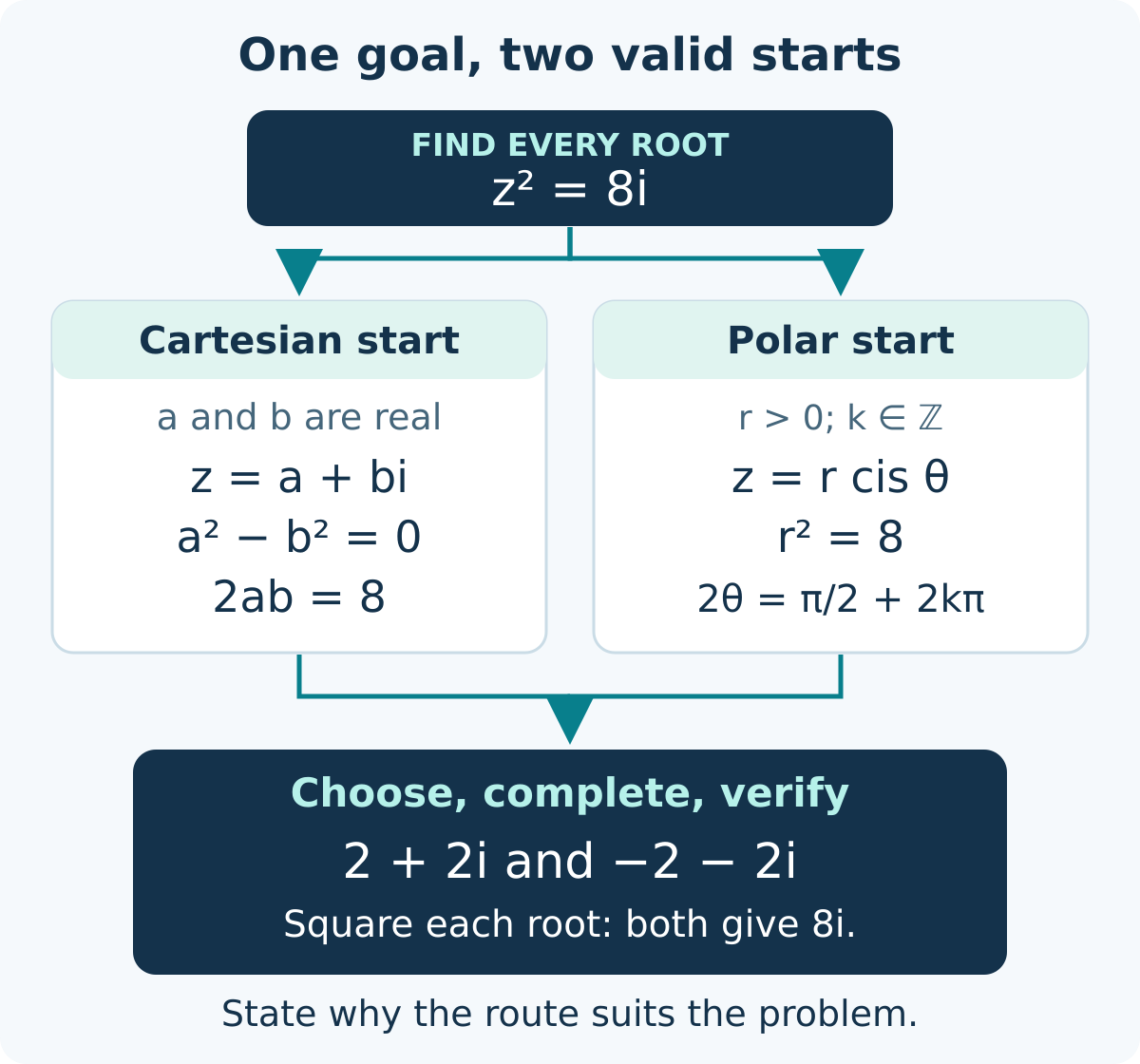
Find all complex numbers z satisfying z2 = 8i. Give your answers in exact Cartesian form.
Before calculating, underline “all” and “Cartesian”. Both affect the finished answer. A single root is incomplete, and an answer left only in polar form does not meet the requested form. Next, ask which features favour each method: equating real and imaginary parts creates simple equations, while polar form handles powers directly.
Sketch two possible starts
Route A: use Cartesian form. Write z = a + bi, where a and b are real. Expanding and matching parts gives:
a2 − b2 = 0 and 2ab = 8.
This start exposes a simple relationship between a and b. It also keeps the working in the form requested for the answer. Its main trap is losing a sign choice when solving the equations.
Route B: use polar form. Write z = r cis θ, where cis θ means cos θ + i sin θ. Here r > 0 because z cannot be zero. Since 8i = 8 cis(π/2), the modulus and angle conditions are:
r2 = 8 and 2θ = π/2 + 2kπ, where k is an integer.
This start organises the roots by modulus and angle. You must include the distinct angle choices and convert back to Cartesian form. All angles here are in radians.
Complete and verify a route
Choose Route A for this example because its equations are especially simple. From a2 = b2, either a = b or a = −b. But ab = 4 is positive, so a = −b is impossible for real a and b. Therefore a = b and a2 = 4.
The two roots are z = 2 + 2i and z = −2 − 2i. Check them against the original equation:
(2 + 2i)2 = 4 + 8i − 4 = 8i.
The second root is the negative of the first, so its square is also 8i. The case split above shows that no other real pairs (a, b) were omitted.
For a comparison check, Route B gives r = 2√2 and θ = π/4 + kπ. Taking k = 0 and k = 1 gives the same two roots; other integer values repeat them. Record your decision in one sentence: “Cartesian form was convenient because matching parts gave two simple equations.” Avoid turning that observation into “Cartesian is always quicker”.
Change the problem before repeating the method
Now try z3 = 8i, again finding every root in exact Cartesian form. Pause before expanding (a + bi)3. What changed?
Polar form now gives a particularly organised start: r = 2 and θ = π/6 + 2kπ/3. For k = 0, 1 and 2, the roots are √3 + i, −√3 + i and −2i. Check the modulus, cube the polar forms and confirm that the three answers are distinct.
Cartesian expansion remains valid. The point is to notice that the higher power changes the amount of algebra, so your earlier preference deserves reconsideration. Cover the answers and reproduce this decision later without the worked example beside you.
Put the decision into a small mixed set
Add a few already-taught questions requiring different approaches, such as a vector calculation and an integration problem. Use your teacher’s material or the current-design VCAA examination resources. Hide topic labels where practical. Before each solution, write the feature that makes your chosen method suitable.
A randomised classroom study by Rohrer and colleagues found that interleaved practice improved delayed test performance across 54 seventh-grade mathematics classes. It supports practising strategy selection among known problem types, but did not test this two-route routine or VCE outcomes. Students received corrective feedback, and time on task was not measured. Treat mixing as one part of revision, alongside instruction and focused practice when a method is still insecure.
Finish with a decision checklist
- What must the answer contain, and in which form?
- Which condition makes each proposed method valid?
- What feature favours the route I chose?
- Have I checked signs, branches and completeness?
- Can I choose again when one important feature changes?
Use Loav’s Specialist Mathematics study guides to revisit a weak topic, then plan a fresh attempt with the study routines and revision guide. Want feedback on your next step? Request a trial lesson with Loav and tell us which subject and skill you would like help with.
