
You can remember a Physics formula and still leave the reader guessing about your reasoning. A written explanation needs to identify the situation, connect a relevant principle to the change, and describe the resulting outcome. The aim is a short chain of reasoning that someone else can follow.
Try planning with five prompts: system, change, principle, outcome, assumptions. These are a revision aid, not an official marking checklist. Use the parts that answer the actual question rather than forcing every response into the same paragraph.
Name the system before choosing a formula
Start by identifying the components involved and the quantity the question asks about. “The voltage increases” is ambiguous if there are two coils and two voltages. Naming the secondary coil makes the claim testable.
Consider this original practice question:
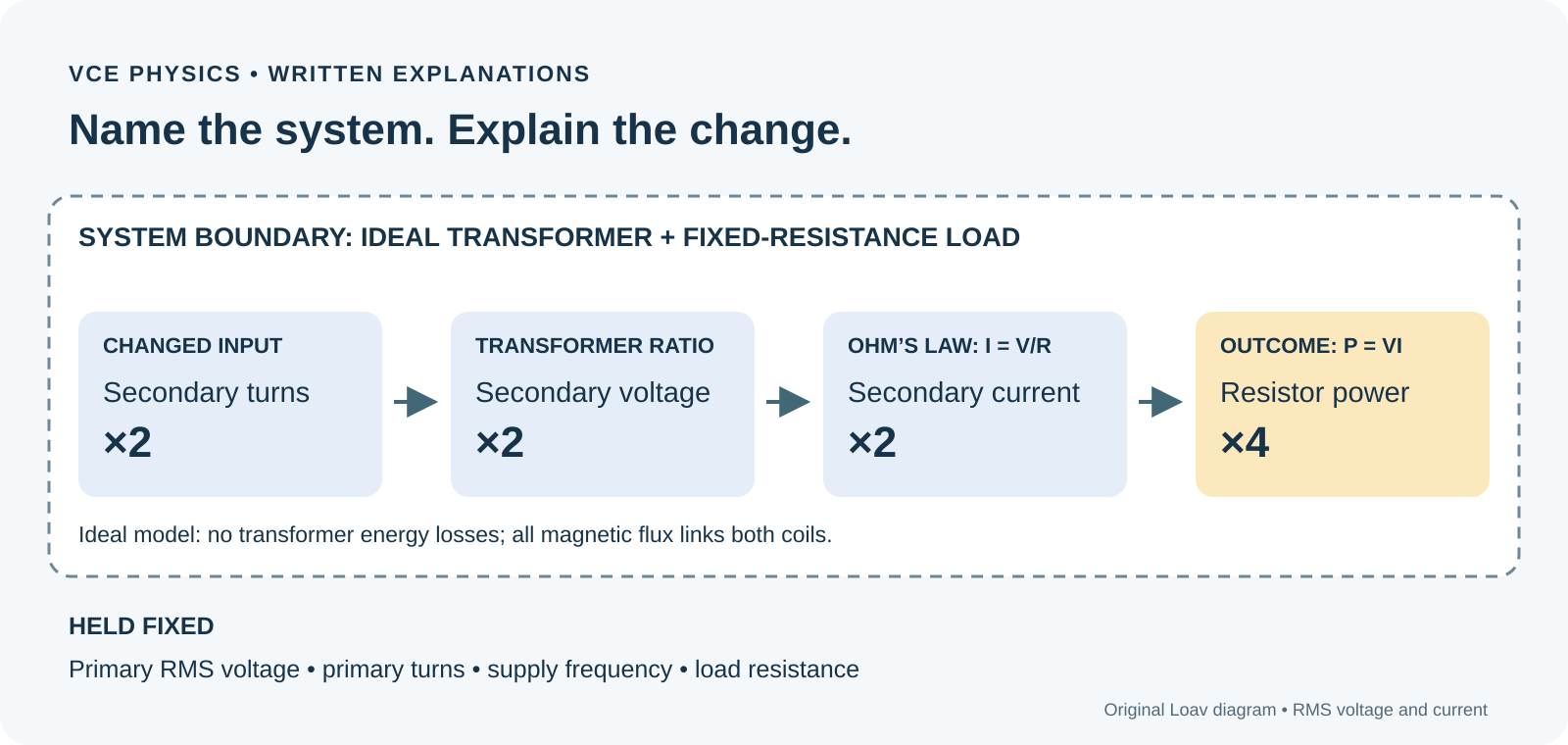
Two ideal transformers each have a 400-turn primary connected to a 12 V RMS alternating supply. Transformer A has 100 secondary turns; transformer B has 200. Each secondary supplies an identical 12 ohm resistor whose resistance remains constant. Explain how the average power dissipated in B’s resistor compares with that in A’s resistor.
Draw a boundary around the transformer and its load resistor. Electrical energy enters from the supply and is transferred to the resistor, where it becomes thermal energy. The question concerns the resistor’s power, not just the transformer’s voltage.
If this comparison were organised as an investigation, the independent variable would be the number of secondary turns. The dependent variable would be the resistor’s average power. Controlled variables would include primary voltage, primary turns, supply frequency and load resistance. “Current stays constant” does not belong on that list: current is allowed to respond.
State the principle and say what stays fixed
For an ideal transformer, the secondary-to-primary voltage ratio equals the secondary-to-primary turns ratio:
Vs/Vp = Ns/Np
Here the voltages are RMS values. Because the primary voltage and primary turns are unchanged, doubling the secondary turns doubles the secondary voltage. A’s secondary voltage is 3 V; B’s is 6 V.
The physical connection is electromagnetic induction. The changing magnetic flux links the coils, and the induced voltage depends on the number of turns and the rate of change of flux. The ideal model assumes that all the flux links both coils and neglects energy losses.
The transformer relation, current and power equations appear on the VCAA 2026 Physics formula sheet. Looking up an equation is a starting point; your explanation must show which quantities are fixed in this particular comparison.
Connect the change to the requested outcome
Do not stop after finding that the voltage doubles. For the constant-resistance load, I = V/R, so doubling its RMS voltage also doubles its RMS current. Average power is P = VI for this resistive load. Doubling both factors makes the power four times as large.
A compact answer could read:
With primary voltage and primary turns unchanged, doubling the secondary turns doubles the secondary RMS voltage. Because the load resistance is constant, the secondary RMS current also doubles. Therefore, the resistor’s average power is four times as large, using P = VI.
A numerical check gives 0.75 W for A and 3 W for B. The calculation checks the comparison; the preceding sentences explain it.
One tempting mistake is to say that increasing voltage must reduce current because transformer power is conserved. Within each ideal transformer, input and output powers are equal. That does not require two different loaded arrangements to draw the same input power. Here B draws more power from the supply. Conservation of energy has not failed; the assumed comparison was wrong.
Check the reasoning, then transfer it
Read your answer against the task before comparing it with feedback:
- Have you named the relevant component and quantity?
- Have you explained why the change produces the outcome?
- Have you stated the conditions needed for that conclusion?
- Have you answered the requested comparison, rather than a nearby question?
Now change one condition. Suppose B has twice the secondary turns but four times the load resistance. Its secondary voltage still doubles, but its current is now half A’s current. Its power is therefore unchanged. If your original explanation cannot adapt to that variation, revisit the step where resistance enters the reasoning.
Use the current VCAA Physics examination resources and your teacher’s feedback to practise with appropriate questions. Keep the original exercise above separate from official examination material.
Make one short explanation part of revision
A 1994 study by Chi and colleagues found greater learning gains among students prompted to explain a science text than among students who read it twice. It involved only 24 eighth-grade students learning the circulatory system, and the groups spent different amounts of time studying. It did not test this brief exercise or predict VCE results.
For a manageable next step, write one explanation without notes, check its links, then try a changed scenario. Our VCE study skills guide can help you fit this into revision. You can also explore VCE tutoring at Loav.
Want feedback on your next study step? Request a trial lesson with Loav and tell us which subject and skill you would like help with.
