
You recognise both terms in your Biology notes, but when a question puts them together, their details start to merge. A location belongs to one process, an outcome belongs to the other, and a sentence that sounded confident becomes difficult to check.
Try revising the distinction directly. Choose two related ideas, compare them using the same dimensions, and then write a short answer that connects both sides. This original Loav routine is designed for content you have already studied, rather than as a replacement for learning an unfamiliar topic.
If you need to reconstruct the stages of one process first, use our single-process explanation routine. Here, the focus is different: deciding which of two related processes fits a description and writing a direct comparison.
Choose a pair for a reason
Start with a mistake from your own work. Perhaps you used a term correctly in isolation but selected it in the wrong situation. Write down exactly what you confused before opening your notes.
A useful pair has something meaningful in common and a distinction worth explaining. Avoid filling a page with every similarity you can think of. If a question concerns the products of two processes, an unrelated list of locations will not resolve it.
For today's example, use transcription and translation in the expression of a nuclear protein-coding gene in a eukaryotic cell. The current VCAA Biology study design includes transcription, RNA processing in eukaryotic cells and translation by ribosomes. This makes the pair suitable for a focused revision exercise. The particular prompt and routine below are Loav practice, not an official examination task.
Build a small comparison from memory
Draw two columns headed with the process names. Add three shared row labels:
- What information is used?
- What is produced?
- Where does this occur in the stated cell context?
Close your notes and complete each row briefly. Leave an honest question mark where you are unsure. A blank gives you something precise to investigate; a guessed sentence copied repeatedly can make the confusion harder to notice.
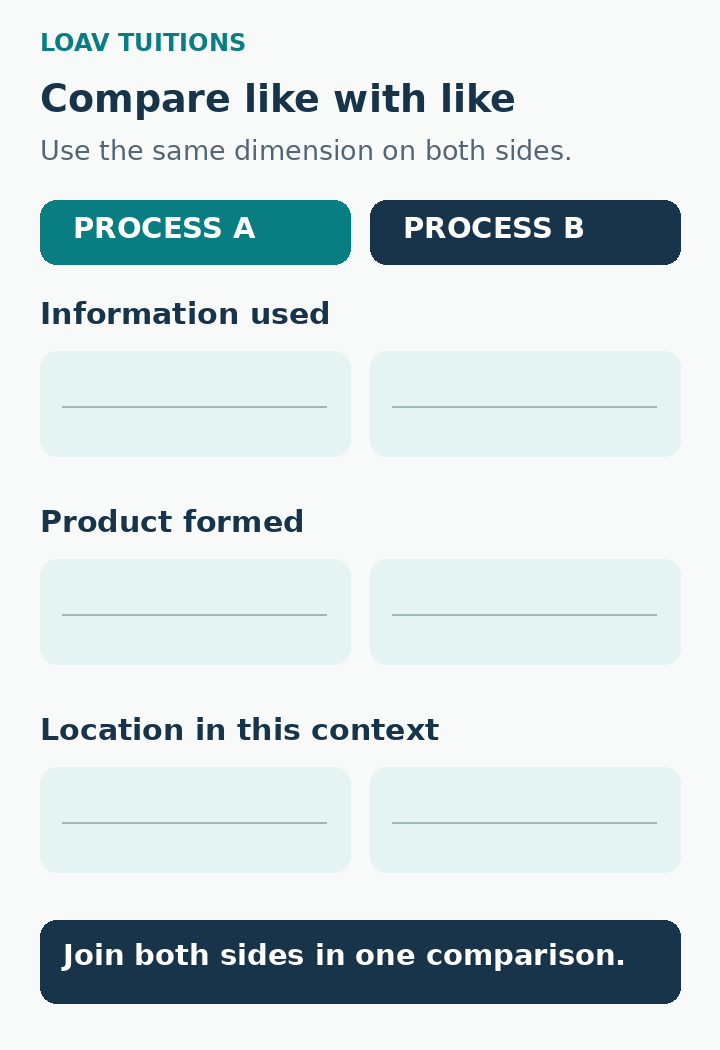
For this example, transcription uses a DNA template to produce an RNA transcript. Translation uses information in mRNA to assemble a polypeptide at a ribosome. For a nuclear protein-coding gene, transcription occurs in the nucleus; translation takes place at ribosomes in the cytoplasm. The NHGRI transcription explanation and translation explanation provide concise checks of the central information-to-product distinction.
Keep the context visible. Do not turn “in this eukaryotic example” into a claim about every cell or every genome. Also leave room between the two processes for the RNA-processing step in your course notes. A two-column comparison should clarify a sequence, not erase an important stage.
Turn paired facts into one comparison
Cover the grid and answer this original practice prompt: Compare the information used and the product formed during transcription and translation.
A direct comparison could be: “Transcription uses a DNA template to form an RNA transcript, whereas translation reads mRNA to assemble a polypeptide.” Both sides address the same dimensions. The sentence does more than state that the processes are different.
Now inspect your own answer:
- Have I named both processes?
- Does each side answer the same part of the question?
- Have I separated the information being read from the product being made?
- Have I used a precise product rather than a vague phrase such as “genetic material”?
Do not force every comparison into one sentence. If the question asks for two differences, give two clearly paired differences. If it asks for a similarity, identify a shared feature rather than writing two unrelated facts. Let the question determine the structure.
Check in another colour, then repair the explanation
Open your trusted class materials and verify each entry. Mark a factual error differently from an incomplete statement. For example, naming RNA as the product is different from incorrectly claiming that a polypeptide is produced during transcription.
Beside each correction, write a short reason: “I confused the product of this stage with the product of the later stage.” Then close the source and rebuild only the row you corrected. Recopying an entire neat table can consume time without testing whether that particular distinction is now clear.
If two resources appear to disagree, compare their contexts before deciding one is wrong. Check the organism, cell type and stage being described, then ask your teacher about the remaining uncertainty.
Apply the distinction to a fresh description
Next, describe a process without naming it: “A ribosome uses the sequence of an mRNA molecule while assembling a polypeptide.” Identify the process and underline the clues that justify your answer. Then write a second description for the other process.
Return to the pair on a later day with the headings hidden. Can you identify the process from its input, product or location, and explain why the alternative does not fit? Change the wording so you are recalling the relationship rather than the layout of your page.
McDaniel and colleagues' classroom research found benefits from low-stakes science quizzes with feedback in an eighth-grade setting. That supports giving recall and correction a place in revision, but it did not test this comparison grid or establish a particular VCE result.
Finish with one useful next step
Choose one current-design question from the VCAA Biology examination resources. Answer the question actually asked, then use its report to check the relevant response. Keep a short record of the distinction you still need to revisit.
For planning the rest of your revision, see our study routines guide. Want feedback on a confusing comparison? Request a trial lesson with Loav and tell us the topic and the point you would like help with.
