
You may have a passage you enjoy writing: a particular voice, an image or an experience that gives you something worth exploring. The revision challenge is deciding which parts still belong when the title and stimulus change. A polished opening is only useful if the rest of the piece can answer the task in front of you.
Use the exercise below to practise that decision before writing another complete response. It is a Loav practice routine, not an official task, predicted examination topic or prescribed writing formula.
Check the task before opening your old draft
The current VCAA English examination specifications require one written text for Section B, excluding song, poetry and verse. Your writing needs to connect the provided title, relevant ideas from at least one unseen stimulus and one Framework of Ideas. It must have a clear purpose: to explain, express, argue or reflect, potentially combining purposes.
Keep the title, Framework and stimulus set together. The 2025 external assessment report explains that these cannot be mixed across different Frameworks. It also identifies forcing a prepared response into a new task as a limitation. The practical question is therefore: what does this particular combination invite me to explore?
On your planning page, write three short notes: the tension in the title, an idea suggested by your chosen stimulus, and the connection to your Framework. If all three notes say only “growth” or “change”, make them more precise before drafting.
Try a fresh original practice prompt
This example uses Writing about personal journeys. If you have studied another Framework, use the same planning routine with suitable material from your teacher.
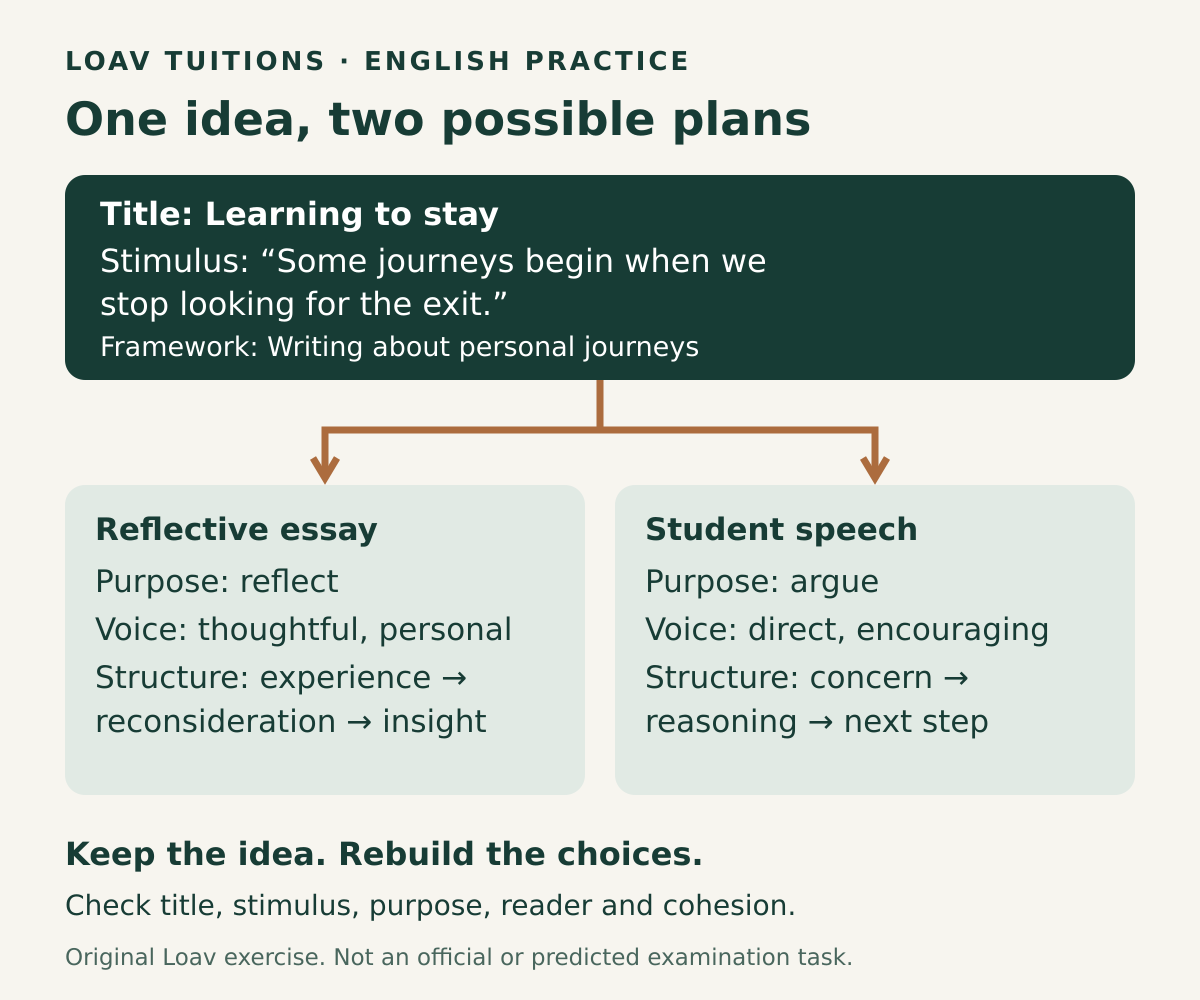
- Loav practice title: Learning to stay
- Original stimulus: “Some journeys begin when we stop looking for the exit.”
- Idea to investigate: staying can involve a difficult decision rather than passive acceptance.
Do not treat the stimulus as a claim you must agree with. A thoughtful response could explore when persistence is valuable and when leaving remains necessary. The title should shape that exploration throughout the text, rather than appearing only in the first and last lines.
Plan two genuinely different approaches
Keep the central idea, but change the purpose and structure. Spend a few minutes on each plan instead of writing two full pieces.
Plan A: a reflective personal essay
Imagine a narrator who repeatedly abandons a difficult musical skill whenever progress slows. Address readers who recognise the discomfort of being a beginner. Begin with a small present-day choice to return to practice, move into an earlier moment of avoidance, then reconsider what the narrator once called freedom. The ending can show a changed understanding of commitment without pretending the difficulty has disappeared.
Here, the stimulus informs the narrator’s changing interpretation of escape. Details about practice matter because they reveal that interpretation, not because a long sequence of events is needed.
Plan B: a speech for students entering a new school
Argue that belonging sometimes develops through repeated small acts of participation. Begin by acknowledging the urge to withdraw, develop an example of returning to an unfamiliar club, consider the difference between healthy persistence and tolerating harm, then invite a manageable next step. Use direct address and carefully chosen contrasts to connect with this audience.
The same idea now needs a public, encouraging voice and a line of argument. A private confession copied from Plan A may no longer serve the purpose. Neither plan is an official model or preferred form.
Write the section where your thinking changes
Choose one plan and draft the middle section where the initial assumption becomes more complicated. This prevents an attractive opening from doing all the work. In Plan A, the narrator might recognise that leaving protected pride rather than independence. In Plan B, the speech might acknowledge a reasonable objection before refining its argument.
Then read the section aloud. Check whether the voice fits its reader, whether each sentence advances the idea, and whether the transition makes the change in thinking clear. Cut an image or anecdote that sounds impressive but contributes nothing to the purpose.
Review connections, not repeated keywords
Use this checklist before turning the plan into a complete timed response:
- Can I explain how the title shapes the central idea and its development?
- Does the chosen stimulus influence a meaningful choice, contrast or question?
- Is the Framework connection evident beyond a label at the top?
- Do the structure, language and voice serve the intended purpose and reader?
- Would changing the title require a substantial revision? If not, is the response too generic?
These checks translate the specifications’ emphasis on ideas, cohesion, voice, structure and fluent expression into revision questions. They are not a separate marking scheme. Section B asks for the created text; do not append an unrequested commentary explaining your decisions. You can discuss those decisions with your teacher during practice.
Your next practice session
Take one earlier piece and a different practice title. Mark what can remain, what needs reshaping and what must be removed. Rewrite one important section, then ask someone to identify its purpose and prompt connection without seeing your plan.
For broader planning, see our study routines and revision guide. Keep the official English examination resources nearby when checking task requirements.
Want feedback on your next study step? Request a trial lesson with Loav and tell us which writing skill you would like help with.
