
A proof can reach the right final line while still containing a gap. Perhaps a denominator could be zero, an inequality has changed direction without explanation, or one successful example has quietly become a claim about every value. A proof audit gives these problems somewhere to show up.
Use this routine on a short argument you have already attempted. Choose an appropriate question from your classwork or the VCAA Specialist Mathematics examination resources, which separate current-study-design papers from older material. Keep the question, your working and a reliable solution nearby, but leave the solution covered at first.
State the claim and its conditions
Before checking the algebra, write what you are trying to establish in one sentence. Circle words such as “every”, “there exists”, “if” and “only if”. List the permitted values and any assumptions supplied by the question.
For example, consider this original practice claim: For every positive real number x, x + 9/x ≥ 6, with equality exactly when x = 3. The word “positive” matters. Testing x = 1 and x = 3 may help you understand the claim, but those checks cannot establish it for every positive real number.
If the statement itself is unclear, pause there. Loav’s guide to logic, quantifiers and proof can help you revisit the language before attempting the audit.
Give each transition a reason
Divide a page into “working” and “reason” columns. Reasons should explain why a move is valid here, rather than simply naming the operation. Read these four lines and fill the missing justification before continuing:
- (x − 3)2 ≥ 0. Reason: the square of a real number is non-negative.
- x2 + 9 ≥ 6x. Reason: expand the square, then add 6x to both sides.
- x + 9/x ≥ 6. Reason: what condition permits this step?
- Equality holds exactly when x = 3. Reason: the original square is zero exactly when x = 3, and the preceding transformations preserve equality.
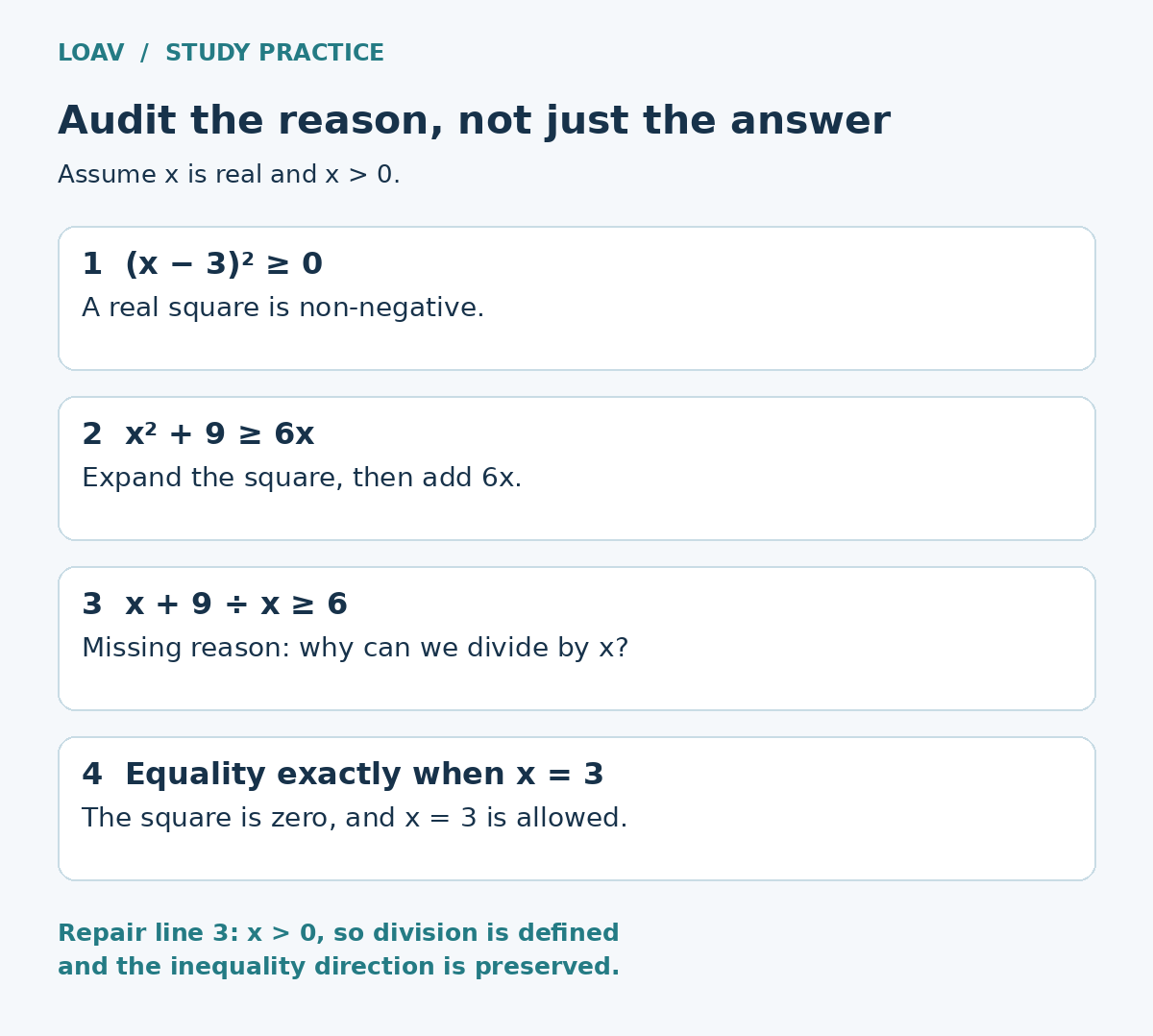
The missing reason is that x > 0: dividing both sides of line two by x is defined and preserves the inequality’s direction. Writing only “divide by x” leaves the important condition unexplained. The equality value also lies in the stated domain.
Now remove the positivity condition as a stress test. At x = −3, the expression x + 9/x equals −6, so the claimed inequality fails. At x = 0, it is undefined. These checks explain why the condition belongs in the statement; the general proof above establishes the claim within that condition.
Look for conclusions you have not earned
Run a second pass that ignores neatness and concentrates on logical gaps:
- Assumptions: Did I use a fact supplied by the question, a previously established result, or something I merely hoped was true?
- Legal operations: Have I checked denominators, square-root restrictions and the sign of quantities used to multiply or divide inequalities?
- Direction: Does one statement imply the next, or are they genuinely equivalent? Squaring both sides can introduce possibilities that need checking.
- Coverage: Have I addressed all permitted cases? If the task asks for an “if and only if” result, have I justified both directions?
- Finish: Does the final sentence establish the exact claim, including any equality condition, rather than a nearby result?
Do not repair an uncertain line by adding “clearly”. Mark the first point you cannot justify and ask a precise question, such as “Why is this expression non-zero?” Compare with the worked solution or ask your teacher or tutor. A valid argument can look different from the model answer.
Rewrite, then try a fresh claim
Use a manageable session rather than auditing an entire paper at once:
- Attempt: choose one short proof and write it without copying the solution.
- Audit: annotate each transition, then apply the checklist.
- Repair: check the doubtful step and rewrite the proof cleanly without looking at the annotated version.
- Transfer: try a comparable statement with one meaningful change.
For a fresh task, prove that x + 16/x ≥ 8 for every positive real x, and identify exactly when equality holds. Attempt it before reading the check: begin with (x − 4)2 ≥ 0; the same positive-division condition is needed, and equality occurs exactly at x = 4.
Record one specific habit to revisit, such as “state the sign before dividing an inequality”. At your next revision session, check that habit in a different question from the Specialist Mathematics study guides.
Why explain the steps?
In Chi and colleagues’ 1994 study, eighth-grade students prompted to explain a science text showed greater gains in understanding than a comparison group. It was a small study involving 24 students, and the prompted group spent longer studying. It did not test VCE proofs or this routine. The practical idea here is to make your reasoning explicit enough to inspect, not to expect a guaranteed assessment result.
Want feedback on your next study step? Request a trial lesson with Loav and tell us which subject and skill you would like help with.
