
You can spot a rhetorical question and still struggle to explain what it is doing. In argument analysis, the useful next step is to connect a writer’s choice to a particular audience concern and the position the writer wants that audience to accept.
This short practice routine focuses on one Section C skill: making that connection precise. It is a revision activity, not a compulsory paragraph formula. The current VCAA English examination specifications ask students to analyse how argument and language persuade an intended audience. They do not require a verdict on whether the argument actually succeeds.
Map the argument before naming devices
Before writing, answer three questions in plain language. What does the writer want? Who is being addressed? How does this part of the argument move those readers towards the proposed position?
Be specific about audience, but stay inside the evidence. “Parents concerned about the cost of school activities” is more useful than “everyone”. However, that description needs support from the source or its context. Do not invent readers’ ages, incomes or political views to make an effect sound detailed.
For a longer source, mark shifts in reasoning rather than dividing it whenever a new technique appears. The writer might establish a shared concern, address a likely objection, then propose an action. Your analysis should explain that movement.
Try this original short source
Fictional context: A school council member writes to parents in the school newsletter, proposing a trial of free library access after school.
Some families have a quiet desk waiting at home; others have a crowded kitchen table. Keeping our library open until five on two afternoons would give more students a place to begin their homework. Parents are right to ask what supervision would cost. That is why we should start with a four-week trial, publish the costs, and review attendance before deciding whether to continue.
The contention is support for a limited trial. The argument first presents unequal access to study space, then acknowledges a financial concern, and finally offers a reviewable proposal. This sequence matters: the trial is presented as a practical response to both educational need and parental caution.
Notice that the source says nothing about examination results. An analysis claiming the writer promises higher marks would add an idea that is absent. Close reading includes knowing what you cannot reasonably claim.
Connect the choice to its purpose
Choose one small piece of evidence. Ask what its wording contributes to the argument before giving it a label.
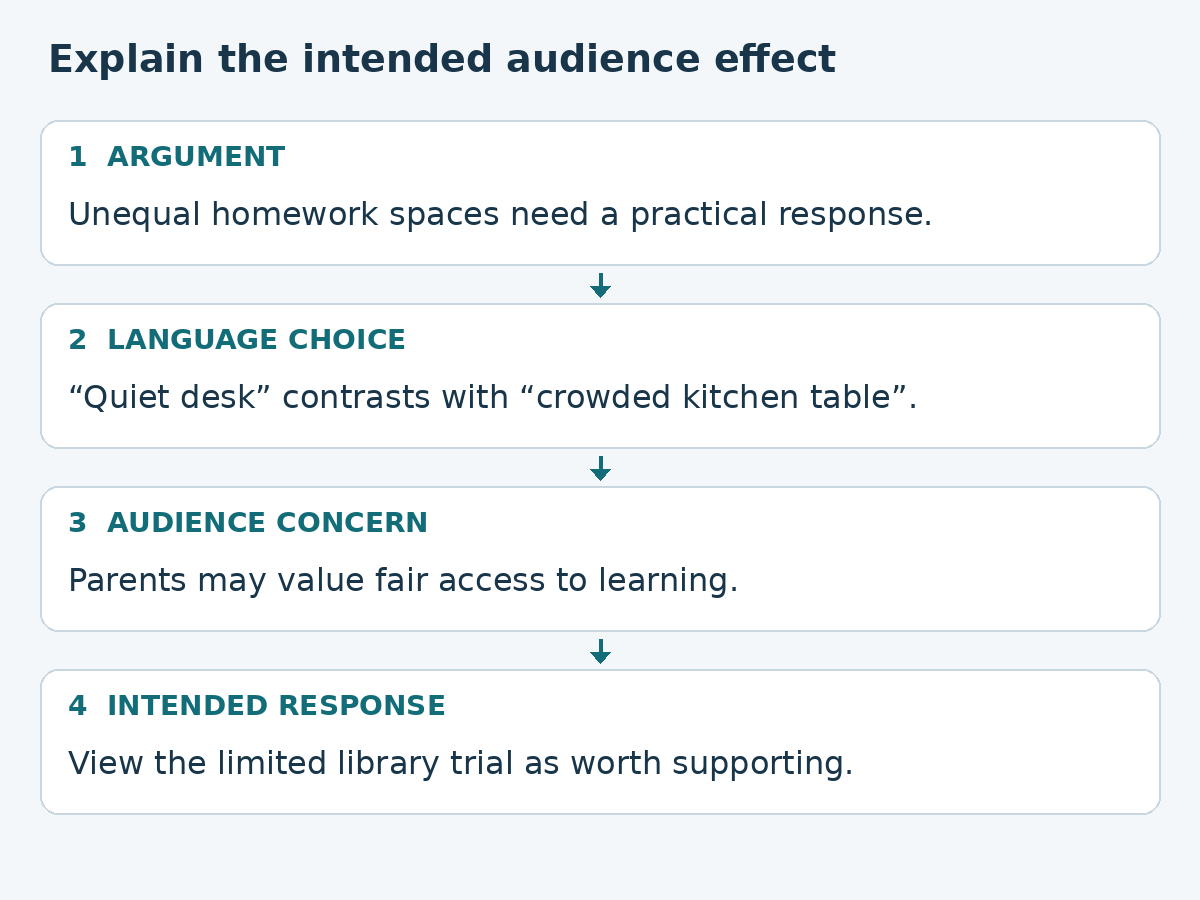
Model analysis: The council member presents access to a suitable homework space as an unevenly shared opportunity. By contrasting a “quiet desk” with a “crowded kitchen table”, the writer gives parents a familiar domestic comparison through which to consider that inequality. For parents who value fair access to learning, this contrast may make the library proposal appear a practical way to support students whose homes offer less space. The writer thus seeks to position the trial as a response to differing circumstances rather than an optional convenience.
The model begins with an idea, integrates brief evidence and explains how that evidence supports the writer’s purpose. “May make” recognises that an intended effect is an interpretation, not a measured response from every reader.
Now consider the second move. Acknowledging that parents are “right to ask” about cost gives the objection legitimacy. The subsequent trial and review may reassure cost-conscious parents that supporting the proposal need not mean accepting an indefinite expense. This explanation is stronger than simply saying the writer “uses inclusive language”.
Repair one vague sentence
Start with this deliberately weak sentence: “The writer uses contrast to make the audience feel guilty and agree.”
Underline the unsupported leap. Nothing in the passage establishes that all parents feel guilty. Replace the emotional prediction with a concern grounded in the source: unequal study conditions. Then name the action being encouraged: support for the library trial.
A repaired version might read: “The contrast between the two study spaces invites parents concerned about fairness to view the library trial as a practical response to unequal access at home.” It is still worth adding close discussion of the quoted wording when developing a full paragraph.
Use a twelve-minute practice cycle
- Three minutes: map the position, audience and progression without naming techniques.
- Four minutes: write one idea-led analytical paragraph using a short quotation.
- Three minutes: circle the audience concern and underline the intended response. Check both against the source.
- Two minutes: replace one generic phrase, such as “engages the reader”, with a specific explanation.
On your next attempt, analyse the concession about cost rather than repeating the contrast. Keep any classroom structure your teacher has taught, but use it to organise reasoning rather than fill empty slots. If a source includes a visual, examine its contribution to the argument instead of treating it as decoration.
For further practice, use the current materials on the VCAA English examination resources page. Check your work against the criteria in the specifications: argument, persuasive choices, evidence and clear expression. Keep this Section C practice distinct from the textual analysis in our English text-study guides, and fit it into a manageable revision routine.
Want feedback on your next study step? Request a trial lesson with Loav and tell us which subject and skill you would like help with.
