
You can recognise every label on a Biology diagram and still struggle to explain what happens next. A useful revision check is to close the page, rebuild one process from memory and explain the links between its stages.
For VCE Biology revision this October, keep the task narrow. One carefully checked explanation can reveal a missing step, a confused location or a causal link that needs work. You do not need an attractive poster or a long recording.
Choose a process you have already been taught
Pick one process from your current class material, such as transcription, translation or an enzyme-catalysed reaction. Avoid combining a whole topic into one attempt. Write a specific prompt that names where your explanation starts and finishes.
Use your teacher's materials to check the scope. The VCAA Biology examination page provides examination specifications, papers and reports, and separates examinations relevant to the current study design from older materials. VCAA warns that papers from previous study designs are not necessarily a guide to the current examination. Choose practice questions accordingly.
Draw four parts without your notes
Close your textbook, slides and completed diagrams. On a blank page, sketch the process using four prompts:
- Starting conditions: What must be present before the process can happen?
- Structures and location: Which molecules, structures or compartments matter, and what does each do?
- Sequence: What changes at each stage, and what makes the next stage possible?
- Outcome: What is produced or changed by the end?
Use simple shapes and short labels. Put a question mark beside anything uncertain rather than looking it up immediately. If you remember a name but cannot explain its role, mark that too. The page should show what you can currently retrieve, including the gaps.
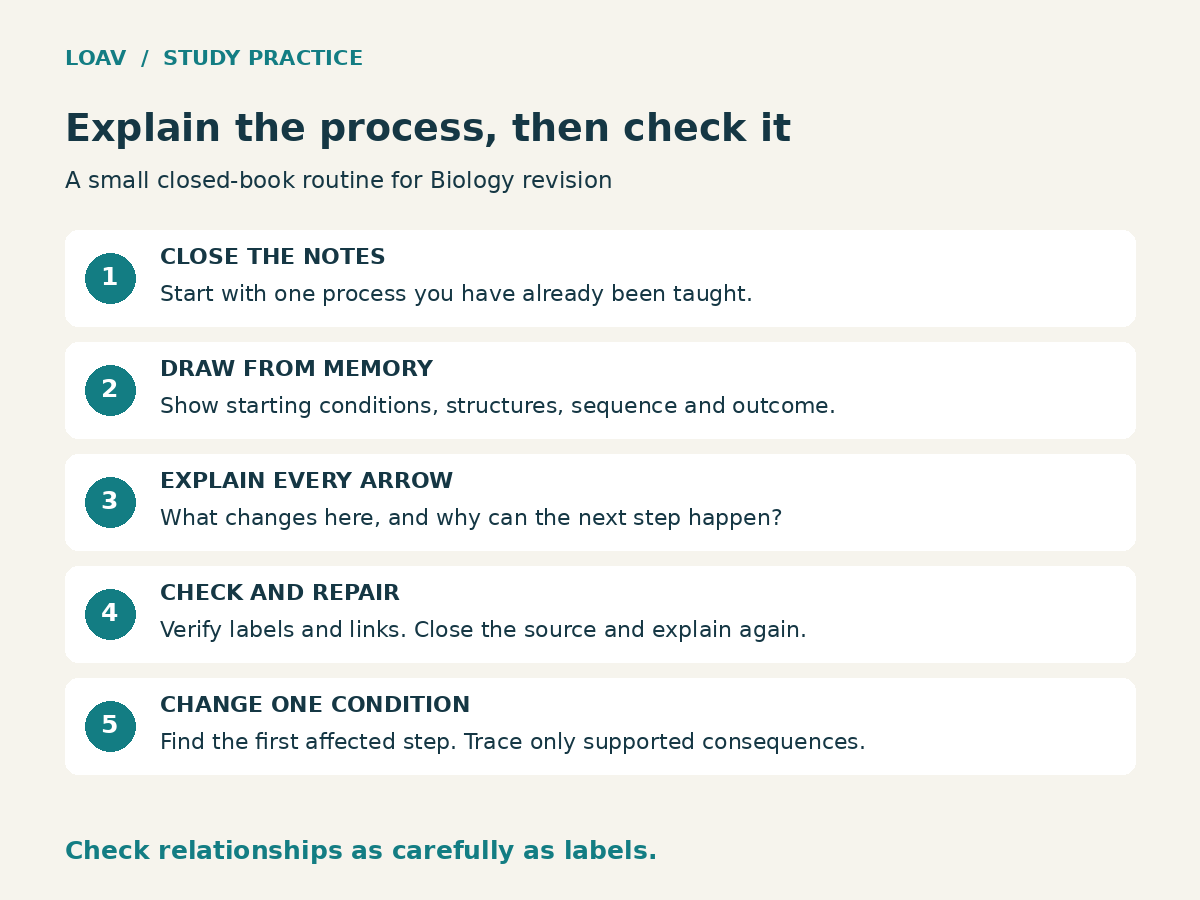
Explain the arrows, not just the labels
Talk through your sketch as though a classmate cannot see the original diagram. At each arrow, explain what happens and why. Be precise about whether the arrow represents movement, a chemical change or one event enabling another.
A sequence of correct terms can hide a weak explanation. Try adding because or this allows between two stages, then check whether the resulting sentence is biologically accurate. Naming an enzyme is not enough if you cannot describe what it acts on or what changes.
If you become stuck, leave a gap and finish the parts you can explain. There is no need to invent a mechanism to keep the explanation flowing.
Open the notes and check every connection
Compare your attempt with a reliable class explanation or textbook. Check every arrow as carefully as each label. Ask whether the starting materials, location, sequence and final outcome agree with the source.
Use a second colour to distinguish three kinds of repair: a missing fact, an incorrect fact and an unexplained connection. Write the corrected explanation beside the specific gap. Copying a whole model answer can make it harder to see what actually needed attention.
Then close the source and explain the repaired section again. If the source does not resolve your question, take that exact arrow or sentence to your teacher or tutor.
Change one condition and trace the consequence
Once the original explanation is accurate, test it with one small change. State what changes and what stays constant before predicting an outcome.
For example, imagine a simple enzyme-catalysed reaction with one required substrate. The enzyme, temperature and pH remain unchanged, but the substrate is absent from the start. No product can be formed by that reaction because there is no substrate for the enzyme to convert. This does not mean the enzyme has been destroyed or that every other reaction in a cell stops.
Draw the consequence on your original sketch. Identify the first affected step, then follow only the consequences your knowledge supports. Check your prediction afterwards. This example is a practice prompt, not an examination prediction or a substitute for the detail required in your course.
What the research supports
In McDaniel and colleagues' 2011 study, Year 8 science students completed low-stakes multiple-choice quizzes with feedback. Quizzed material was remembered better on later assessments than material that was not quizzed. The study supports retrieval practice with feedback, but it did not test this particular drawing routine or VCE Biology results.
In Chi and colleagues' 1994 study, 14 Year 8 students prompted to explain a circulatory-system text showed greater gains in understanding than 10 students who read it twice without those prompts. This was a small study of explanation during reading, not a direct trial of closed-book VCE revision. It offers a reason to practise explaining relationships, without guaranteeing an assessment outcome.
Finish with a short written response
Try one relevant examination-style question without the diagram in front of you. Answer the actual question, then use the corresponding report and teacher feedback to review your response. Keep the corrected gap as a prompt for your next revision session.
For help fitting this into a manageable week, see our VCE study routines and revision guide. You can also explore VCE tutoring at Loav or contact the team to request a trial. Bring one attempted explanation and the part you could not confidently check.
