
You might know how to differentiate, integrate and calculate a probability when the worksheet tells you which topic you are doing. A mixed question set asks for another skill: deciding which idea applies before you begin.
This VCE Mathematical Methods revision routine gives that decision a place in your practice. Use it with methods you have already learned. If a technique is unfamiliar, start with teaching and a worked example rather than forcing yourself through a mixed set without support.
Choose a small mixed set
Select four to six questions from different topics you have studied. Use your teacher's materials or questions that fit the current study design. The VCAA Methods resource page separates current-design examinations from older material.
Do not copy complete examination questions into a public revision resource. For your own study, keep a reference to the paper and question so you can return to the official source and its relevant assessment guidance.
Vary the mathematical problem type, rather than switching subjects every few minutes. For example, a short Methods set might contain an equation, a rate question and a probability question. Keep it small enough that you can check the reasoning afterwards.
A classroom trial by Rohrer and colleagues found a delayed-test benefit when seventh-grade maths assignments mixed problem types. This is evidence for considering mixed practice after instruction, not a promise of a VCE score gain. The researchers also noted limitations, including that time spent practising was not measured.
Write a decision line before you calculate
For each question, write three short notes:
- Goal: What quantity or conclusion is being requested?
- Conditions: What domain, interval, units or assumptions matter?
- First move: Which relationship will help, and why?
This can be brief. The point is to make a decision you can later inspect. A formula written without a reason will not tell you whether you recognised the structure or simply guessed.
Try these three original questions
These short examples were written for this article. They are not official VCAA questions or predictions.
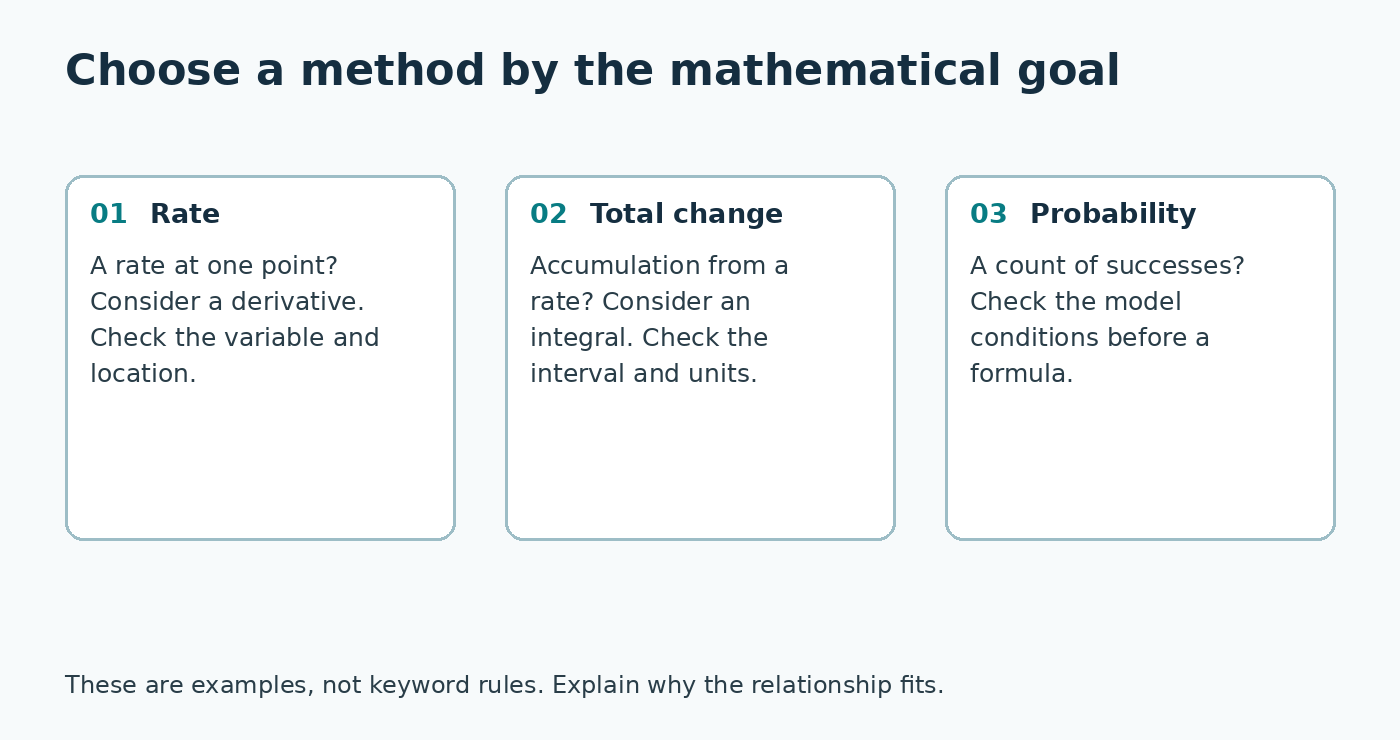
1. A rate at one point
For f(x) = x³ − 3x, find the gradient of the curve at x = 2.
Decision: The goal is the tangent gradient at one input, so find the derivative and evaluate it there.
f′(x) = 3x² − 3, so f′(2) = 9. Substituting x = 2 into the original function gives f(2) = 2, which is the height of the point, not its gradient. Naming the requested quantity helps distinguish these two calculations.
2. A total from a rate
Water enters an initially empty tank at r(t) = 2t + 1 litres per minute for 0 ≤ t ≤ 3. No water leaves. How much enters during those three minutes?
Decision: The goal is an accumulated volume from a rate over an interval, so integrate the rate from 0 to 3.
An antiderivative is t² + t. Its change from 0 to 3 is 12, so 12 litres enter. As a check, the rate rises linearly from 1 to 7 litres per minute. Its average is 4 litres per minute, giving 4 × 3 = 12 litres. This check works here because the rate is linear.
3. A count of successes
Three independent trials each have success probability 0.2. What is the probability of exactly one success?
Decision: The number of trials is fixed, each trial has two outcomes, success probability is constant and independence is given. A binomial model applies.
There are three positions for the single success. The probability is 3 × 0.2 × 0.8² = 0.384. Check that you answered “exactly one”, rather than “at least one”. The result is between 0 and 1, but that check alone would not establish that the model was correct.
Diagnose the choice separately from the calculation
After checking a question, ask whether the first move was suitable. If it was, locate the later algebra, arithmetic or interpretation error. If it was not, revisit the condition or relationship you missed.
Then make a small repair. Explain a relevant worked example, cover it and attempt a fresh question. A long run of questions is unlikely to help if the reason for choosing a method remains unclear.
Later, return to a mixed set in a different order. Notice whether you can select an approach when the previous question no longer suggests what to do next. Avoid treating these decision notes as an extra exam script you must mechanically complete; their purpose is to strengthen your practice.
Keep the examination conditions separate
The current Methods specifications distinguish technology-free Examination 1 from Examination 2, where approved technology and a bound reference are permitted. Examination 1 does not permit your own notes or technology; a formula sheet is supplied.
Label your practice set accordingly. If a question needs an unfamiliar technique, use the Methods study guides and your teacher's explanation before retrying. Visit our study skills hub for related revision routines.
Want feedback on a method you keep overlooking? Request a trial lesson with Loav and tell us which type of question you would like help with.
